We now have an initial version of “Simple C-LARA” on the UniSA server. If you select “Create new C-LARA project using simple C-LARA” from the top-level menu, you will get a stripped-down interface where you just specify a title, the text and annotation languages, and a prompt. In response to a single button press, C-LARA will then write a story based on the prompt and try to create an illustration using DALL-E-3. You can regenerate the text or the illustration, and when you’re satisfied you can turn it into multimedia, including phonetic text for languages where that is supported, with one more button press. If you only want to use simple C-LARA, you can select it with the command “Choose between simple C-LARA and full C-LARA”, and then your menus are simplified a bit.
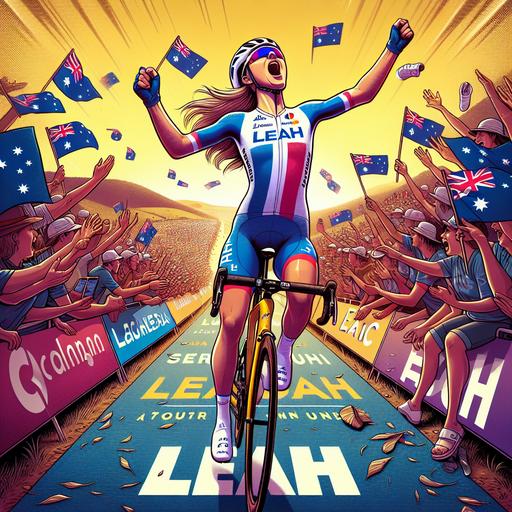
Christèle came round this afternoon to try it out, and we were both impressed with its response to her first experiment. She selected French with English annotations, and said, in French, that she wanted a story of ten lines about a French cycling champion called Leah who came to Willunga, South Australia, to compete in the Tour Down Under and won a brilliant victory. The instructions are already rather complicated; not only that, but Christèle, unfamiliar with my laptop’s keyboard, typed them without accents.
I wondered if GPT-4 Turbo and DALL-E-3 would be up to the challenge. But a couple of minutes later, it came out with a story that exactly matched the spec (you can see it here), and accompanied it with this splendid image:
Well done, AIs!
We both thought that simple C-LARA was decidedly promising, but we need to provide more templates: a piece of text with a single image is too constraining. Christèle suggested adding a couple of picturebook-oriented formats, including one for creating alphabet books. This should be fairly easy to do.
If you try it out, please leave a comment here! Simple C-LARA is completely new, and I’m sure it can be improved in many ways.

 C-LARA
Leave a comment