This week, Anne-Laure and Stéphanie have been visiting from New Caledonia, and we’ve been working on using C-LARA for the Oceanic language Iaai. The report has continued to make progress, and we’ve installed a couple of useful new features. In particular, you can now pay for your OpenAI calls by giving the platform an OpenAI API key linked to your OpenAI account.
Using C-LARA for Iaai
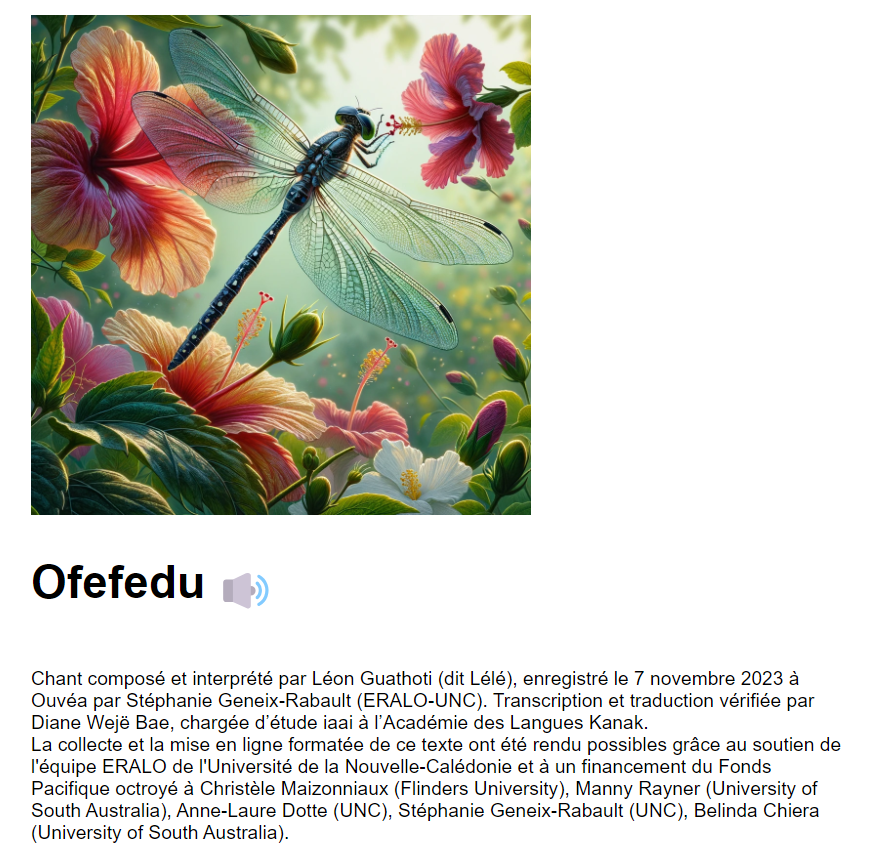
I have been helping Anne-Laure Dotte and Stéphanie Rabault, two linguists specialising in Oceanic languages, to convert some of their material into C-LARA form. Stéphanie, whose research focusses on ethnomusicology, has recorded and transcribed a large number of songs in Kanak languages. She and Anne-Laure now have several of them posted on the C-LARA server. Search for language = Iaai to check them out!
Doing this work revealed some embarrassing bugs in the way the platform was handling recorded human audio. They should now be fixed.
Report
We now have about 115 pages, but are still not quite there.
Using OpenAI API keys
This was an excellent suggestion from Louis. At the beginning of the C-LARA project, it was difficult to get an OpenAI API key valid for GPT-4. I had missed that you can now just create them routinely on the OpenAI site. Follow the instructions here to get set up.
Adding acknowledgements to C-LARA texts
Another useful suggestion came from Anne-Laure and Stéphanie. There’s now an item in the list of project actions called ‘Acknowledgements’, which lets you add acknowledgement text to your C-LARA project. You can provide a short piece of text to be included at the bottom of every page, and/or a long piece of text to be included either at the beginning or the end.
Next Zoom call
Thu Mar 14 2024, 20:00 Adelaide (= 09.30 Iceland = 09.30 Ireland/Faroe Islands = 10.30 Europe = 11.30 Israel = 13.00 Iran = 17.30 China = 20:30 Melbourne/New Caledonia)

 C-LARA
Leave a comment