This week, I’ve been testing the picture book functionality, added some features people have suggested for segment translations and pinyin, fixed some bugs, and started looking at the Esperanto subproject again.
Picture books
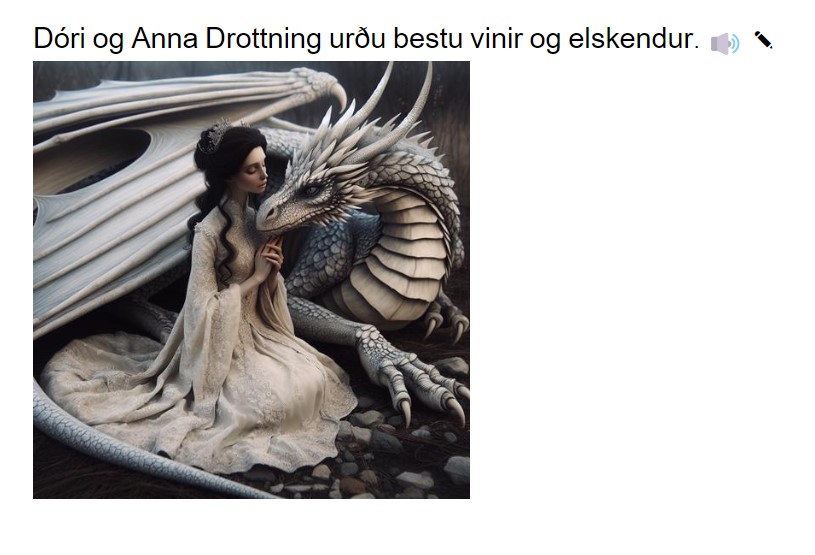
I’ve created a first example of a picture book intended to serve a real purpose. A bridge player friend has recently married an Icelander and wants to learn her husband’s language. I asked if she would like a C-LARA picture book, and after some discussion we agreed on a story about a dragon who falls in love with a queen who is an expert bridge player, and has to learn bridge to win her heart. The result is posted here.
I found it was harder to create this book than previous ones. Here are the problems we had to deal with:
- When I showed the text to Sölvi, he pointed out quite a few errors in the Icelandic and had to clean them up. Thank you Sölvi!
- The process of constructing the image generation plan also seemed to work less well in Icelandic. On many steps, the AI failed to include the descriptions needed to maintain coherence, and I had to edit them in by hand.
- Even after adding the descriptions, I found visual coherence was poor. One specific problem seemed to be that the initial image of the queen was very small, so the AI couldn’t get a good description of her. I solved this, more or less, by hand-editing the plan so that the description was taken from a later image, then regenerating all the images where she appeared. I then did another couple of rounds of regeneration for the images I still didn’t like.
Evidently we’d like to have less human intervention. We should soon start investigating whether the AI can take over some of this job, looking at the images itself and making the kinds of changes I did.
Segment translations
It’s now possible to add translations to segments, a feature many people have suggested. The functionality works similarly to the other annotation operations: you can tell the AI to do it, add them yourself, or edit the AI’s version.
You can see what the result looks like in the Icelandic story above. Click on pencil icons to see the translations.
Pinyin
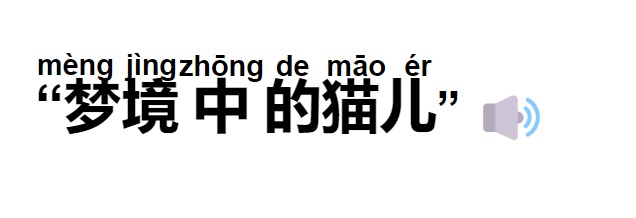
Luna said it would be much better to show pinyin over the Chinese characters rather than in the gloss popups, and Francis suggested that we could do this using the <ruby> tag. The AI found it easy to implement the idea. The result, which Luna and Francis say is good, looks like this:
Fixes
Sölvi told me he couldn’t access the “Edit annotation prompts” screen, and I found it was blocked by an elementary bug that no one had noticed. Evidently we haven’t used the platform enough. Please keep reporting issues!
Esperanto
I have gone back to discussing this with the AI. The core functionality that needs to be implemented is decomposition of words into component morphemes: the great strength of Esperanto is its completely regular morphology. It doesn’t seem to be possible to get a good result with straightforward annotation using few-shot examples, but we think we can improve things considerably if we move to Chain of Thought, as with multi-word expression annotation. We’re implementing an initial solution now.
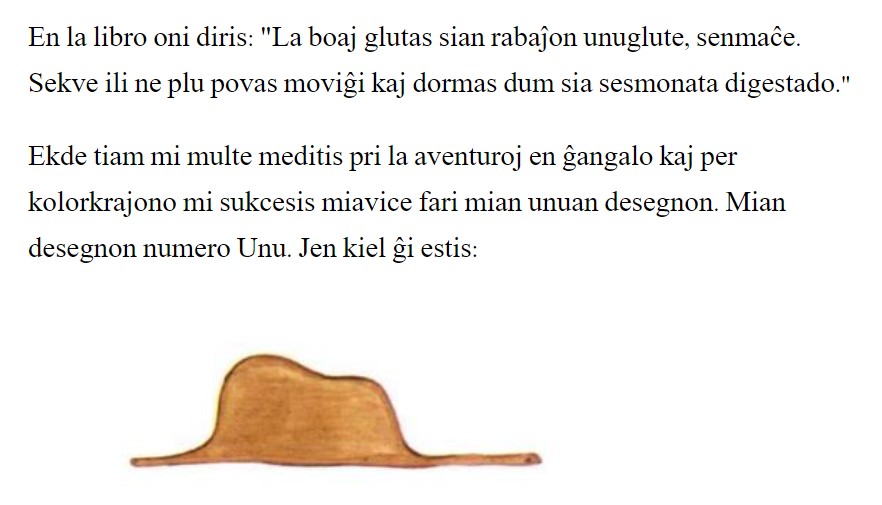
If you’re curious to see what Esperanto in C-LARA looks like, we posted chapter one of the Esperanto edition of Le petit prince (“La eta princo”) here. This however includes a good deal of post-editing.
Next Zoom call
The next call will be at:
Thu Jun 20 2024, 18:00 Adelaide (= 08.30 Iceland = 09.30 Ireland/Faroe Islands = 10.30 Europe = 11.30 Israel = 12.00 Iran = 16.30 China = 18:30 Melbourne = 19.30 New Caledonia)

 C-LARA
Leave a comment