Over the last week, we’ve been focussing on two things: images, which are now starting to work quite well, and the beginnings of our ambitious project to refactor the code-base so that the AI can understand it better.
Images
Sophie has been using the image-generation functionality a great deal over the last few weeks to create material for her Kok Kaper project. The regular feedback I’ve been getting has has a good effect on stabilising the code, which is now working quite well.
The Kok Kaper material cannot be shared without extensive consultation with the community, so I created two substantial examples myself that can be made public.
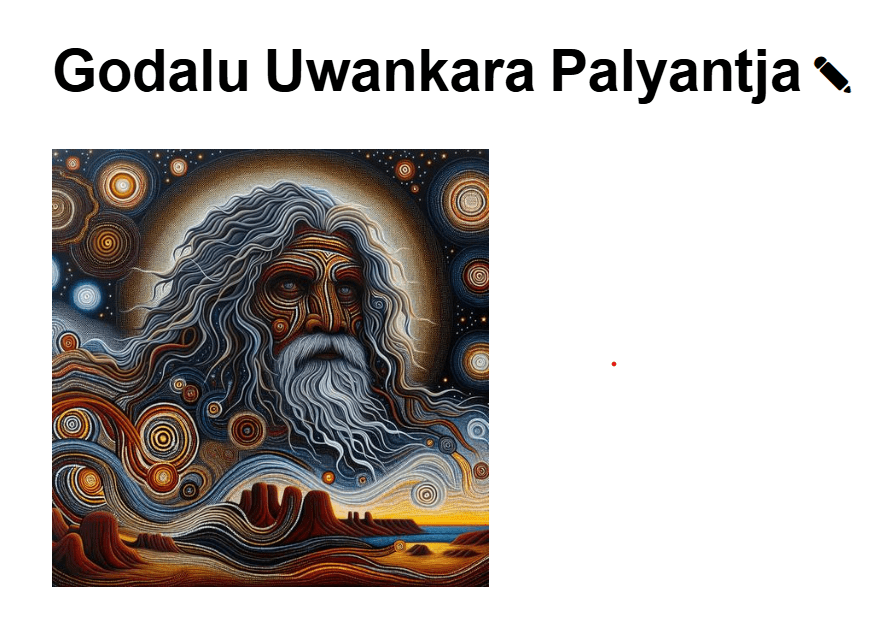
Genesis 1 in Pitjantjatjara. Pitjantjatjara is a Central Australian language spoken in the Western Desert. It is exceptionally well resourced for an Australian language, and there is a lot of material freely available on the web. I downloaded the text from the Pitjantjatjara Bible Project page and asked the AI to choose a suitably respectful and appropriate style itself. You can see the complete C-LARA text here, and I’ve pasted in the cover page below.
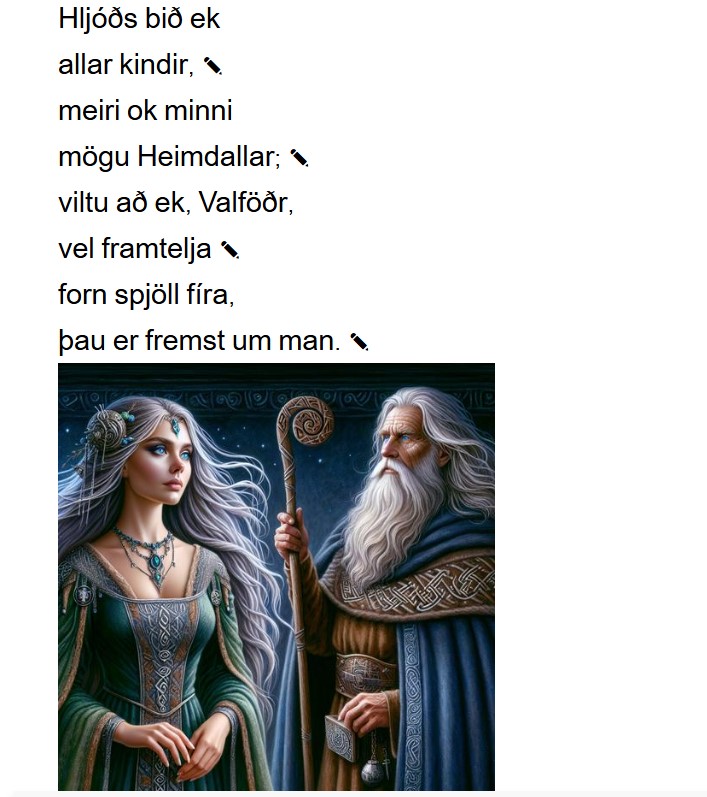
An illustrated version of the Völuspá. Branislav and his students created a LARA version of this famous Old Norse poem a few years ago, but this time we asked the AI to do all the annotation and also add images. The result is posted here; below is the first text page, where the image shows the Völva addressing Odin.
Refactoring the codebase to make it more comprehensible to the AI
We have been kicking this idea around for a while, and now we’ve finally started concrete work. The software development in the project has from the start been organised as a collaboration between the AI and the human, and it’s clear that the AI doesn’t find all tasks equally easy. Sometimes it can do everything; in other cases, it struggles.
Intuitively, it seems the difficult cases usually involve old code that has been allowed to become messy. We would like to understand this better, and in the difficult cases reorganise the code so that the AI can work more effectively. Our plan is to proceed as follows:
- Make the codebase more modular by splitting up the large views.py file into pieces for individual functionalities. I am working with the AI to create tools that can perform the reorganisation programmatically using the RedBaron Python code manipulation package.
- When the modularisation phase is completed, the AI will review the modules to estimate how well it understands each one.
- In the difficult cases, we will work together, with the AI doing as much as possible, to clean things up so that the AI understands things better.
- We will measure the AI’s understanding by logging its responses to requests for bugfixes, new features, documentation etc.
If we can make this programme succeed, it seems to me that the results could be of interest well outside C-LARA.
Next Zoom call
The next call will be at:
Thu Feb 20 2025, 20:00 Adelaide (= 09.30 Iceland/Ireland/Faroe Islands = 10.30 Europe = 11.30 Israel = 13.00 Iran = 17.30 China = 20:30 Melbourne/New Caledonia)

 C-LARA
Leave a comment