Here is this week’s roundup:
UniSA server
The UniSA server is now operational! It would be good to test it more, but several people have used it and I haven’t received any complaints. It is indeed a great deal more responsive than Heroku.
I’m thinking that we should make this available to external people in two stages. Long-term, we want to integrate a credit card based automatic payment service, so that people can top up their own accounts; but we shouldn’t start using this until we’ve completely sure it works. So before that, I’m thinking we could say that the first hundred people who sign up will get an account with $10 of free credit. We’ll get feedback from them, and meanwhile we can install the automatic payments software and test it ourselves.
GPT-4 Turbo
I have added functionality on both Heroku and UniSA to let people switch between GPT-4 and the new GPT-4 Turbo model. You can also adjust the parameter which sets the maximum number of words that can be sent to the AI in a single annotation operation.
We need to test this properly, but early indications using ALTA examples suggest that GPT-4 Turbo with a maximum window of 250 words is a great deal better than the previous configuration of GPT-4 and 100 words.
Publications
- Catia presented C-LARA at WorldCALL, it sounds like it went well!
- We are almost ready with the presentation for ALTA, but we should probably add a couple of slides about the UniSA server and GPT-4 Turbo.
- Branislav suggested submitting a proposal for a chapter to go in an upcoming IGI book. The call is here.
My objection to this is that the book is not supposed to come out until 2025, so our contribution risks being obsolete before it’s even published. But other people may see it more positively. We should discuss.
Melbourne student projects: Annotated Images
I have now finished tidying up the C-LARA support for annotated images, so that it’s possible to attach an arbitrary number of images to a project. Alex says that students will soon send us code and doc so that we can integrate.
There are some interesting options for involving OpenAI software in this process. One obvious idea, which should be easy to implement, is to add access to DALL-E-3. This would let the user automatically designate a piece of text and get an image for it.
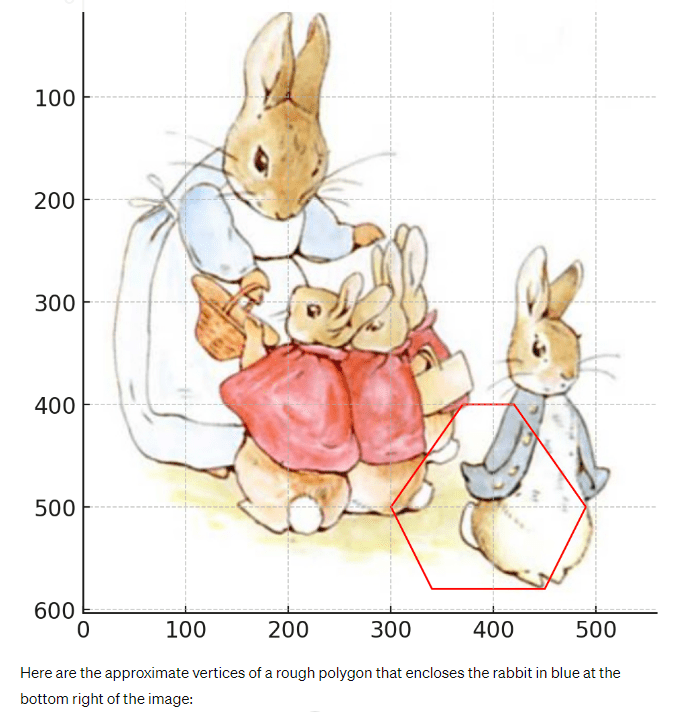
Another idea which right now does not quite work is to ask GPT-4V (the visual input version of GPT-4) to do the image annotation, telling it which objects are going to be highlighted and asking it to draw polygons around them for inclusion in C-LARA. I tried this yesterday. GPT-4V immediately understands what it’s supposed to do and says it’s drawn the right polygon – but in fact, the polygon is not in the right place. My prediction is that this problem will soon be fixed.
Next Zoom call
Note to Southern Hemisphere people: two hours later than winter time, i.e. same time as last week.
Thu Nov 16, 2023, 20:00 Adelaide (= 09.30 Iceland = 09.30 Ireland/Faroe Islands = 10.30 Europe = 11.30 Israel = 13.00 Iran = 17.30 China = 20:30 Melbourne/New Caledonia)


Leave a comment